The Cowichan Sweater: A Buyer's Guide to a Coast Salish Icon
Knit in one piece from thick, undyed, hand-spun wool, a genuine Cowichan sweater carries the weather of the coast in its fibres. Telling the real article from a look-alike is the whole skill, and this guide walks you through it.
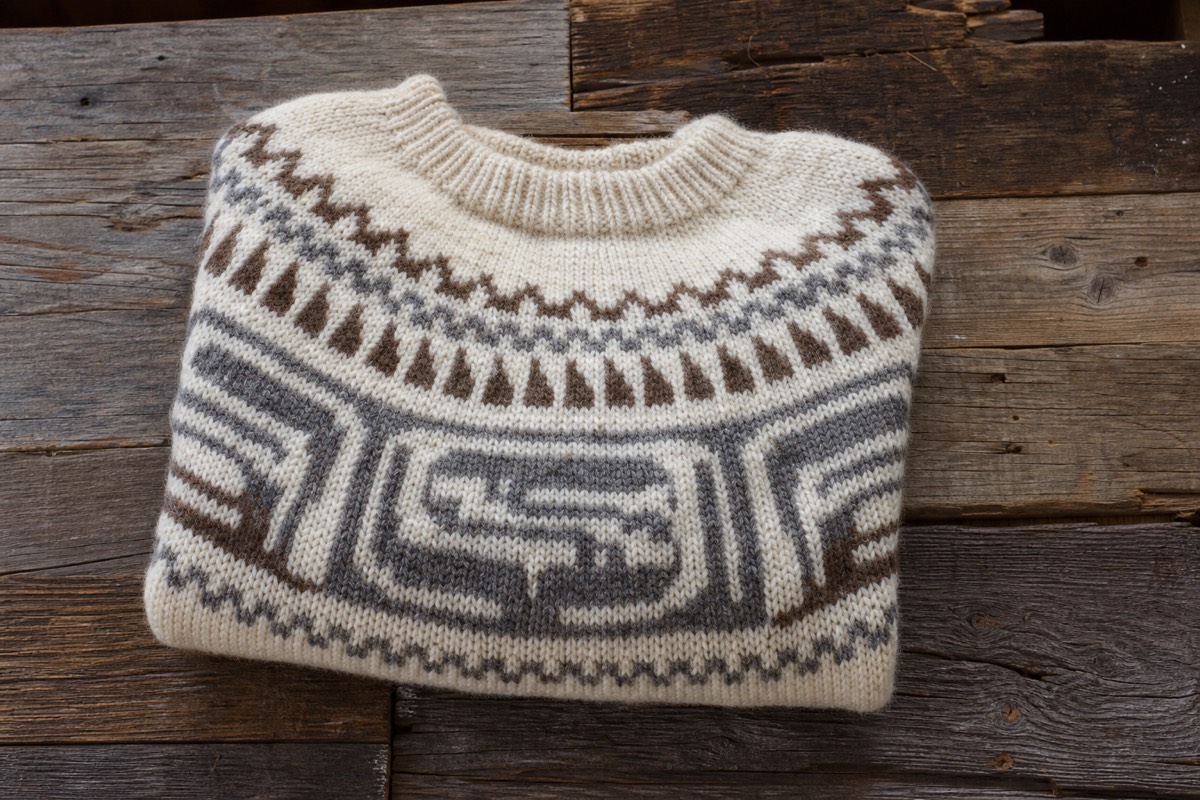
Knit in one piece from thick, undyed, hand-spun wool, a genuine Cowichan sweater carries the damp of the coast in its very fibres. Pick one up and it is heavier than it looks, faintly oily to the touch, and warm in a way that machine-made knitwear rarely manages. That weight and that smell are not flaws. They are the marks of the real thing, and learning to read them is the whole point of this guide.
The Cowichan sweater is a living tradition of the Cowichan people, known in their own language as the Quw'utsun, a Coast Salish nation of the Cowichan Valley on southern Vancouver Island. It is not a souvenir motif or a fashion label. It is a hand-knit garment with a real history, a real technique, and a long and awkward record of being copied by others. Because so many look-alikes exist, buying well means knowing what separates an authentic sweater from a factory imitation, so most of what follows is about telling the difference.
We write this with respect for the knitters and the community whose work it is, and with one firm principle: buying a genuine sweater supports the tradition and the people who keep it alive, while a cheap copy undercuts both. Here is the history, how to spot the real article, what the patterns draw on, what to check before you pay, where to look, what to expect to spend, and how to care for the sweater once it is yours.
Genuine or imitation: what to check before you buy
The maker question settles most doubts: a genuine sweater comes with a named knitter and community.
What is the Cowichan sweater?
The Cowichan sweater is a hand-knit wool garment made by the Cowichan (Quw'utsun) people, a Coast Salish nation of the Cowichan Valley on southern Vancouver Island. It emerged in the late 1800s and early 1900s, when long-standing Coast Salish spinning and weaving skills met European knitting techniques, producing a thick, one-piece sweater in the natural, undyed colours of the wool.
Two threads came together to make it. Coast Salish people had spun and woven for a very long time before contact, working with mountain goat wool, plant fibres, and the wool of the now-extinct Salish woolly dog to make blankets and regalia. In the nineteenth century, European settlers and missionaries introduced knitting needles and knitting techniques. Cowichan knitters, most of them women, combined the new craft with their own spinning knowledge and their own sense of design, and within a generation a distinct garment had taken shape. Knit from heavy, hand-spun, largely unwashed wool, it kept the natural lanolin that makes the sweaters shed rain and hold warmth, and it quickly became both a working garment and a source of family income.
The sweater spread far beyond the valley over the twentieth century. Loggers and fishermen wore Cowichan sweaters for their warmth in wet weather, visitors bought them, and they were given as gifts to visiting dignitaries, which is how a valley craft became recognised across Canada and abroad. That fame cuts both ways. It built a market that supported knitters, and it also drew the imitators whose copies now crowd the souvenir trade, which is the whole reason a buyer needs to know what to look for before parting with any money.
That dual role, cultural marker and livelihood, still holds today. The sweaters are woven into the identity of the valley in the same way the carved poles around Duncan and the wider island are, and a visit to the region is the natural place to understand both. The table below sets out the two roots that feed the tradition.
| Root of the tradition | What it contributed |
|---|---|
| Coast Salish textile heritage | Hand-spinning, wool preparation, and a long design sensibility |
| European knitting, introduced in the 1800s | Needles and knitting technique brought by settlers and missionaries |
| Local raw wool | Heavy, hand-spun, largely unwashed yarn that keeps its lanolin |
| Cowichan knitters' own design | The one-piece construction and the distinctive figured patterns |
How do you tell a genuine Cowichan sweater from an imitation?
A genuine Cowichan sweater is hand-knit in one piece from a single ply of hand-spun, undyed wool, in the natural colours of the sheep: cream, grey, brown, and black. It is heavy and dense, faintly smells of lanolin, uses no dyed yarn, and its patterns and tension carry the small irregularities of handwork. Machine-made copies are lighter, more uniform, and often dyed.
Take the markers one at a time. The wool should be a single, chunky, hand-spun ply, not a smooth commercial multi-ply, and the colours should be the wool's own rather than dyed shades, so you are looking at creams, greys, browns, and blacks with no bright hues. The sweater should be knit in one piece, worked in the round, so there are no shoulder or side seams stitched together from flat panels. It should feel notably heavy, sit dense in the hand, and often carry a faint sheepy, oily scent from the lanolin. And because a person made it, the tension will vary very slightly and the motifs will not be machine-perfect. Those small irregularities are a good sign, not a defect.
The reason all this matters is a long history of imitation. Sweaters sold as Cowichan-style have been mass-produced for decades, and the difference came to national attention during the 2010 Winter Olympics in Vancouver, when official-looking sweaters marketed in the Cowichan style were criticised for not being made by Cowichan knitters. The episode pushed the genuine article into the spotlight and underlined why the maker matters. Cowichan Tribes has worked to protect the name and the tradition, so treat the community connection of a sweater as central, not incidental.
Handle as many as you can before deciding. The difference between a hand-spun single ply and a smooth commercial yarn is obvious in the hand once you have felt both, and the weight of a genuine sweater is hard to fake. If a shop stocks both real and imitation sweaters, ask to compare them side by side, since the contrast teaches your fingers faster than any description on a page. Once you know the feel, you will spot a copy across a market stall.
The comparison below is the one to memorise.
| What to check | Genuine Cowichan sweater | Machine-made imitation |
|---|---|---|
| Wool | Single ply, hand-spun, chunky | Smooth commercial multi-ply |
| Colour | Natural, undyed cream, grey, brown, black | Often dyed, sometimes bright shades |
| Construction | One piece, knit in the round, no stitched seams | Flat panels sewn together, visible seams |
| Weight and feel | Heavy and dense, faint lanolin smell | Lighter, uniform, little or no smell |
| Pattern | Slight handmade irregularities | Machine-perfect repetition |
| Maker | Named Cowichan knitter or community | Unknown factory, no maker information |
What do the patterns mean?
Cowichan sweater patterns combine geometric bands with figurative motifs drawn from the coast, commonly eagles, deer, whales, salmon, and thunderbirds, worked in the natural wool colours. Designs are personal to the knitter and the family rather than a fixed catalogue, so treat any single reading as one story among many rather than a universal code you can decode from a chart.
It is tempting to want a dictionary of symbols, but that is the wrong way to understand these sweaters. A knitter draws on shared motifs and on her own ideas, and the same figure can mean different things in different hands. Geometric bands, zigzags, and diamonds frame many sweaters, and figurative panels bring in creatures of the coast and forest. What the figures share is that they depict the living world of the region rather than abstract logos, and the specific significance belongs to the maker. Respecting that means admiring the design and, where you can, learning its story from the knitter or a cultural source rather than assuming.
Colour does some of the work that dye does elsewhere. Because the palette is limited to the natural shades of the wool, the design has to carry through contrast and shape rather than bright hues, which is part of why the figures read so cleanly against their background. A skilled knitter places a motif so it sits balanced on the body of the sweater, and no two hand-made pieces line up exactly the same way. That individuality is a feature to enjoy, not a flaw to correct, and it is one more thing a machine cannot reproduce.
The valley itself is the best place to see how deep this runs, from the carvings around Duncan to the wider living culture you encounter on a Cowichan Valley day trip. The table below lists motifs you will often see and what they typically depict, offered as a starting point for appreciation rather than a fixed key.
| Motif | What it commonly depicts |
|---|---|
| Eagle | The bald eagle of the coast, a frequent figured panel |
| Deer | Black-tailed deer of the island forests |
| Whale or orca | The whales of the surrounding waters |
| Salmon | The salmon central to coastal life |
| Thunderbird | A powerful figure from coastal stories |
| Geometric bands | Zigzags, diamonds and lines framing the figures |
What should you check before you buy?
Before buying, ask who knit the sweater and where, check that the wool is undyed and hand-spun, confirm it is knit in one piece with no stitched seams, feel the weight, and be wary of a price that seems too low for many hours of handwork. A seller who can name the knitter and the community is the single strongest sign you are holding the real thing.

Treat the purchase like meeting the sweater's history. The best sellers will tell you who made it, often by name, and where they are from, and they will not be thrown by the question. Turn the garment inside out to look for seams, which a genuine one-piece sweater will not have. Check that the colours are natural and the yarn is a single hand-spun ply. Lift it to feel the weight, and give it a gentle sniff for the lanolin. Then let the price sanity-check the rest: a real sweater is many hours of spinning and knitting, so a bargain-bin price is a red flag rather than a find. Run through the checklist below before you commit.
| Check | A good answer looks like |
|---|---|
| Who made it? | A named Cowichan knitter and community the seller can identify |
| Is the wool hand-spun and undyed? | Single chunky ply in natural sheep colours |
| Is it one piece? | No stitched shoulder or side seams inside |
| How heavy is it? | Notably dense, with a faint lanolin scent |
| Does the price fit the work? | Well into the hundreds, reflecting the hours involved |
Where can you buy an authentic Cowichan sweater?
Buy from Indigenous-owned retailers, cultural centres, and sellers who source directly from Cowichan knitters, concentrated in and around Duncan in the Cowichan Valley. Avoid generic souvenir shops selling cheap look-alikes with no maker information. The safest purchase is one where the seller can tell you the knitter's name and community.

We deliberately do not print shop names and prices here, because retailers, stock, and ownership change, and a genuine sweater is often sold directly or through Indigenous-owned outlets rather than a fixed storefront. What stays constant is what to look for in a seller. Indigenous-owned galleries and retailers, community cultural centres, and dealers who buy straight from knitters are the reliable channels, and Duncan, the main town of the valley, is where they cluster. Be cautious with tourist gift shops and unverified online listings that show a low price and no information about who made the sweater. When in doubt, the maker question settles it.
Online buying deserves extra caution. A photograph cannot convey weight, single-ply texture, or the lanolin smell, and the listings that flood the market with cheap Cowichan-style sweaters rely on that gap. If you do buy at a distance, favour Indigenous-owned sellers and community outlets that name the knitter, ask for detail on the wool and the construction, and be ready to walk away from any listing that cannot answer plainly. Buying in person, in the valley, is simply the surer way to choose your first one.
The valley is an easy trip from Victoria over the Malahat, which is why a sweater hunt pairs so well with a wider day out. A guided run up the same corridor, such as the private Butchart Gardens and Malahat SkyWalk day tour, gives you the drive without the wheel, and the longer Cathedral Grove and waterfalls day tour travels the Highway 1 route that passes through the valley on its way north. The table below sorts the sellers by how much confidence each tends to warrant.
| Where to look | What to expect | Confidence |
|---|---|---|
| Indigenous-owned retailers and galleries | Sweaters sourced from named knitters | High |
| Cultural centres and community sellers | Direct community connection and context | High |
| Direct from a knitter | You meet the maker and hear the story | Highest |
| Reputable specialist dealers | Provenance offered on request | Medium to high |
| General souvenir shops | Often Cowichan-style copies, no maker named | Low, ask hard questions |
How much should you expect to pay, and why?
Expect a genuine hand-knit Cowichan sweater to cost well into the hundreds of dollars, because each one represents many hours of hand-spinning and knitting in heavy wool. A very cheap sweater is the clearest single warning sign of a machine-made imitation. Treat the price as a reflection of skilled labour, not a tourist markup.
Do the arithmetic in your head and the price makes sense. Someone spun the wool, someone designed the pattern, and someone knit the whole garment in one dense piece by hand, which takes many hours across days. That labour is the cost. We do not quote a fixed figure here because prices vary by size, knitter, and complexity, and they move over time, so confirm the current price with the seller. What we can say plainly is that a price far below the going rate almost always means the sweater is not what it claims to be. The tiers below are a guide to reading a price tag rather than a price list.
| Price level | What it usually signals |
|---|---|
| Very low | Almost certainly a machine-made imitation |
| Mid | Ask hard questions about the maker and wool |
| Well into the hundreds | Consistent with a genuine hand-knit sweater |
| Higher, for large or complex pieces | Reflects size, detail, and the knitter's reputation |
How do you care for a Cowichan sweater?
Care for a Cowichan sweater by washing it rarely and gently, by hand in cool water, and drying it flat, never in a machine, which felts the wool and strips the lanolin that keeps it water-resistant. Air it out between wears instead of washing, store it folded rather than hung, and spot-clean marks rather than laundering the whole garment.
Moths are the other thing to guard against, since natural wool is exactly what they seek out. Store the sweater clean and folded with a natural deterrent such as cedar, check it over between seasons, and keep it somewhere dry, because damp is as much an enemy as heat. Treated this way, a genuine Cowichan sweater lasts for decades and often outlives the trip it came home from, which is a large part of why the price makes sense measured over a lifetime rather than a single season.
Raw wool wants very little from you, which is part of its appeal. The lanolin that makes the sweater shed rain also resists odour, so airing it outdoors usually does the job that washing would do for other knitwear. When it genuinely needs cleaning, use cool water and a gentle wool wash, handle it as little as possible, press the water out without wringing, and lay it flat to dry so it holds its shape. Heat and agitation are the enemies: a hot wash or a tumble dryer will shrink and felt the wool and leave you with a smaller, stiffer garment. Store it folded in a drawer, since hanging a heavy sweater stretches the shoulders out of shape.
| Do | Avoid |
|---|---|
| Air it out between wears | Washing it often |
| Hand-wash gently in cool water when needed | Hot water or machine washing |
| Dry it flat, pressing out the water | Wringing or tumble drying |
| Store it folded in a drawer | Hanging it, which stretches the shoulders |
| Spot-clean small marks | Laundering the whole sweater for one stain |
How does a sweater hunt fit a Cowichan Valley day?
A sweater hunt pairs naturally with a Cowichan Valley day trip from Victoria, over the Malahat to Duncan and its totem-lined downtown, with wineries, cideries, and farm kitchens close by. If you would rather not drive, a guided day up the same corridor handles the route while you browse, taste, and take in the culture.
The valley rewards making a day of it rather than a single errand. Duncan sits at the centre, its walking route of carved poles a short stroll, and the region's wine and food are spread across the surrounding country roads. A morning of looking for the right sweater, an afternoon among the cellar doors, and a stop to read a few of the poles makes for a full and unhurried day. For the food and wine half, our guide to Cowichan Valley wine country lays out a sensible loop, and if you want a wilder counterpoint on another day the west-coast seals and rainforest day tour heads the opposite direction into ancient cedars and beaches.
Timing helps here too. The valley is at its liveliest through the warmer months, when markets, farm gates, and tasting rooms keep full hours, so a spring-to-autumn visit gives you the best chance of finding sellers open and stock on the shelves. In the quieter winter months, call ahead or lean on the year-round Indigenous-owned retailers rather than assuming every door is open. Either way, treat the sweater as the anchor of the day and let the food, the wine, and the carvings fill the hours around it.
However you build the day, buying a genuine sweater is the part that lasts. Start from our guided island day trips to sort the transport, read more about the wider region at vancouverisland.travel, and dig into the craft itself through the reference on Cowichan knitting before you go. Buy well, and you carry home not a souvenir but a piece of a tradition made by hand a few fields from where you stood.