Where to See Totem Poles on Vancouver Island
From the footprint-marked walk through Duncan's downtown to the carved poles of Thunderbird Park in Victoria, Vancouver Island puts monumental cedar carving out in the open. Here is where to find the poles, and how to read them.
Choose the public pole site that fits your route. Compare Victoria, Duncan, and Alert Bay before reviewing optional guided add-ons.
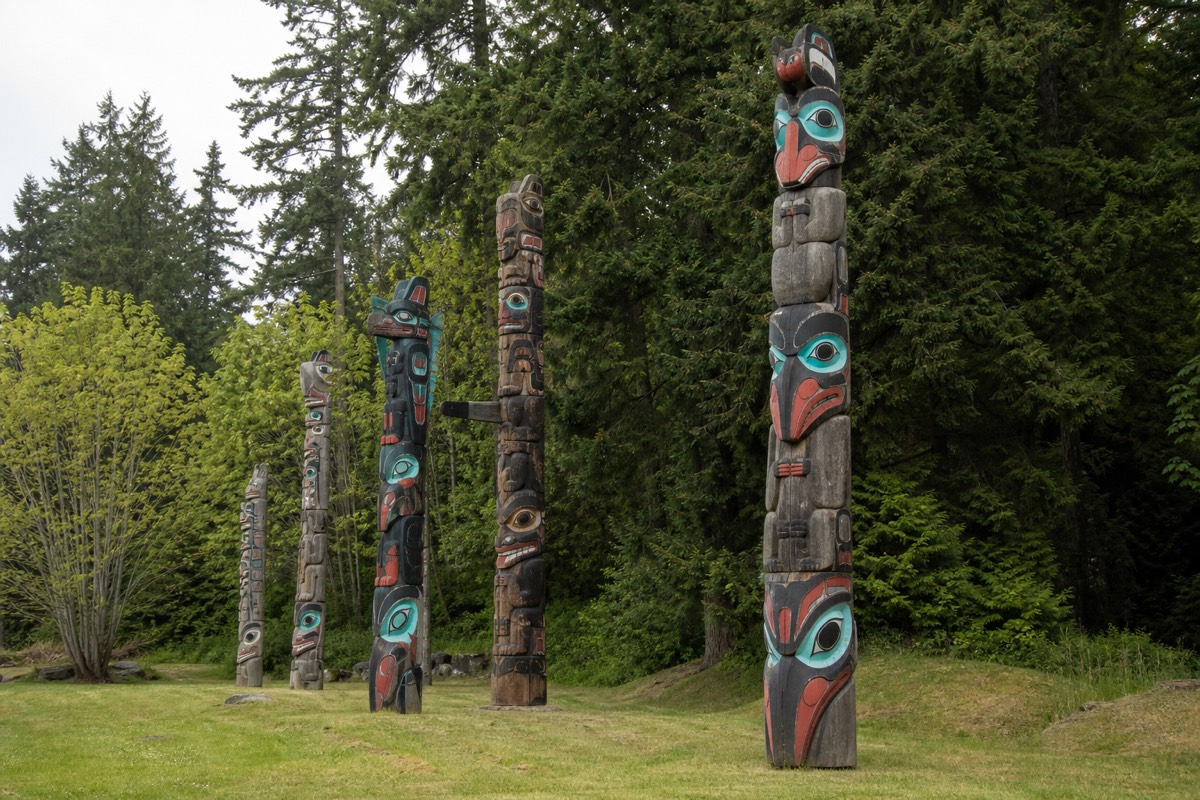
Follow the painted line through downtown Duncan and you pass carved cedar pole after carved cedar pole, dozens of them, set among the shops and street corners of an ordinary working town. An hour south in Victoria, a cluster of poles stands beside the Royal BC Museum in the open air of Thunderbird Park. Vancouver Island puts monumental carving out where anyone can walk up to it, and this guide is about where to find the poles and how to read them with respect.
Totem poles are a tradition of the First Nations of the Pacific Northwest coast, carved from red cedar to record family lineage, tell stories, honour people, and mark important events. On Vancouver Island you will see poles by Kwakwaka'wakw, Nuu-chah-nulth, Coast Salish, and other carvers, some standing in their home communities and some raised for public display. They are not relics of a vanished past. Carving is a living art here, and the poles you see include work made in the last few decades as well as older pieces.
What follows covers the three best places to see poles on the island, what the carvings mean, the different kinds of pole and their purposes, and how to view them respectfully, along with how to fold a totem visit into a wider trip. We write it with care, because these are cultural objects belonging to living communities, not scenery.
Three places to see totem poles, south to north
See Thunderbird Park on a Victoria day, catch Duncan on the drive north, and treat Alert Bay as its own north-island trip.
Where can you see totem poles on Vancouver Island?
The three best places to see totem poles on Vancouver Island are Duncan, known as the City of Totems, in the Cowichan Valley; Thunderbird Park beside the Royal BC Museum in Victoria; and Alert Bay on Cormorant Island off the north island, home to the U'mista Cultural Centre. All three are public, and viewing is free or low cost.
Each site has a different character. Duncan is a self-guided walk through a town that made its poles a civic project, so you see carving woven into daily life. Thunderbird Park is a compact, curated collection in the heart of Victoria, easy to add to a city day. Alert Bay is a destination in its own right on the north island, and the most significant of the three for Kwakwaka'wakw culture and history. The table below sums up where each sits and what you will find.
| Place | Where it is | What you will see | Getting there |
|---|---|---|---|
| Duncan, City of Totems | Cowichan Valley, about an hour north of Victoria | Several dozen poles on a self-guided downtown route | Highway 1, an easy drive or a stop on the way north |
| Thunderbird Park | Beside the Royal BC Museum, central Victoria | A pole collection and a Kwakwaka'wakw big house | Walkable in downtown Victoria |
| Alert Bay | Cormorant Island, off the north island | Burial-ground poles, a very tall pole, the U'mista collection | Ferry from Port McNeill, a north-island trip |
Which one you prioritise depends on how much time you have and where your trip already takes you. In Victoria for a day, Thunderbird Park is the easy answer. Driving up the island, Duncan is right on the route. Making the effort to reach the north island, Alert Bay is the deepest experience of the three. The table below matches the sites to the shape of your trip.
| Time you have | Best totem experience |
|---|---|
| Half a day in Victoria | Thunderbird Park and the Royal BC Museum |
| A day heading up the island | Duncan, the City of Totems, on the drive north |
| A full cultural day from Victoria | Thunderbird Park plus Duncan in the Cowichan Valley |
| A north-island trip | Alert Bay and the U'mista Cultural Centre |
What are totem poles, and what do they mean?
Totem poles are monumental cedar carvings made by the First Nations of the Pacific Northwest coast to record family lineage and crests, tell stories, honour people, and mark important events. The stacked figures are family crests and characters from a story, not idols to be worshipped, and a pole is read as one connected design rather than a ranking from top to bottom.
Two misconceptions are worth clearing up at the start. A pole is not a religious idol, and the figures are not ranked by height, so the phrase about being low on a totem pole has nothing to do with how the carvings actually work. What the figures usually are is crests, the animals and beings a family holds the right to display, along with characters from the stories those crests carry. Reading a pole means knowing the family and the story behind it, which is why the same figure can carry different meaning on different poles. Carved from western red cedar, the wood of the coast, poles were and are raised at significant moments, and the raising itself was often the heart of a ceremony.
Carving nearly disappeared and then came back, which is part of what you are seeing when you look at a pole today. Government policy through the late nineteenth and early twentieth centuries suppressed the ceremonies that poles were raised for, and the knowledge thinned as a result. A revival from the mid twentieth century onward, led by master carvers passing the work to new generations, brought it back, so many poles now standing are recent works in an old tradition rather than survivors from long ago. Reading a pole with that history in mind turns it from an artefact into evidence of a culture that held on.
The figures below appear again and again along the coast. We list what each commonly depicts, with the caution that the specific significance always belongs to the family and the carver rather than to a fixed public code.
| Figure | What it commonly represents |
|---|---|
| Eagle | A widely held crest, associated with the sky |
| Raven | A central figure in many coastal stories |
| Thunderbird | A powerful supernatural being of the upper world |
| Bear | A crest linking the human and animal worlds |
| Wolf | A family crest tied to strength and kinship |
| Orca and salmon | Beings of the sea central to coastal life |
What are the different kinds of totem poles?
Totem poles come in several kinds: house frontal poles that stood against a family home, memorial poles raised to honour a person, mortuary poles that once held remains, welcome figures that greeted arrivals at a village, and ridicule or shame poles that recorded a debt or a wrong. Each served a specific social purpose rather than being simply decorative.
Knowing the type helps you read what a pole was for. A house frontal pole marked the home and lineage of the family living behind it, sometimes with a doorway through its base. Memorial poles were raised to remember an important person after their death, while mortuary poles, less common today, once held the remains of the honoured dead. Welcome figures, often single large carved figures rather than stacked poles, stood at the water's edge to greet those arriving by canoe. Ridicule poles, sometimes called shame poles, were a public way of recording an unpaid debt or a wrong, and could be taken down once the matter was settled.
Not every carving on the coast is a totem pole in the strict sense, either. House posts stood inside a big house to hold up the roof beams and often carried carved figures, welcome figures greeted canoes without telling a lineage story, and smaller carvings served countless other purposes. On southern Vancouver Island in particular, Coast Salish carving leaned toward house posts and welcome figures more than the tall free-standing poles most associated with nations further north. Knowing that helps you place what you are looking at rather than lumping every carving under one label.
The table below lays out the purposes side by side.
| Type of pole | Purpose |
|---|---|
| House frontal pole | Marked a family home and its lineage |
| Memorial pole | Honoured an important person after death |
| Mortuary pole | Once held the remains of the honoured dead |
| Welcome figure | Greeted arrivals at a village landing |
| Ridicule or shame pole | Recorded a debt or a wrong publicly |
Duncan, the City of Totems
Duncan, the main town of the Cowichan Valley, is called the City of Totems for the several dozen poles set around its downtown, many carved by Coast Salish and other First Nations artists. A self-guided walking route, marked by a painted line and footprints on the pavement, links the poles in an easy loop of about an hour.
Duncan began installing its poles as a civic project in the 1980s, and the collection grew into one of the largest public displays of carving anywhere. The pleasure of it is how unstaged the setting feels: poles stand outside the train station, beside car parks, and on ordinary corners, so you come across them as you walk rather than filing past an exhibit. The marked route makes it simple to see most of them without a map, and interpretive signs give context for many. Because Duncan sits in the heart of the Cowichan Valley, a totem walk slots naturally beside the valley's other draws, from the Cowichan sweater tradition that carries the same Coast Salish heritage to the wineries and farm kitchens spread across the surrounding country.
Give the walk an unhurried hour and read a few of the signs rather than photographing every pole and moving on. The carvings reward a little attention, and the town has cafes and shops along the route to break up the loop. Duncan is also an easy stop on the drive up the island, which makes it one of the simplest totem experiences to build into a trip that is heading somewhere else.
Duncan makes a natural half-day when you fold in the rest of the valley. The carvings, a coffee, and a browse for a genuine sweater fill a morning, and the wine country sits a short drive away for the afternoon. Because the poles stand out in the weather among the town's daily life, Duncan shows the tradition as ongoing rather than archived, which is a different feeling from seeing carvings behind museum glass. Take a moment to notice the range of styles too, since the poles here come from carvers of several nations rather than a single hand.
Thunderbird Park and Victoria
In Victoria, Thunderbird Park sits beside the Royal BC Museum at the edge of the Inner Harbour and gathers a collection of totem poles alongside Wawadit'la, a Kwakwaka'wakw big house built by the master carver Mungo Martin in 1953. The park is open to the public and free to walk through, and the museum next door holds one of the finest First Nations collections in the country.
Thunderbird Park is the easiest place on the island to see poles if you are already in Victoria, being a short walk from the harbour, the Parliament Buildings, and the museum. Many of the poles standing outside are carved replicas, with fragile originals preserved indoors at the Royal BC Museum to protect them from the weather, which is itself part of how the tradition is being cared for. Wawadit'la, the big house raised by Mungo Martin, is a landmark of the carving revival of the mid twentieth century, a time when this work was being actively renewed after decades of suppression. The park pairs well with the museum's galleries, and both fit inside a broader plan for the city in our guide to things to do in Victoria and the tighter single day in Victoria itinerary.
If you are on a guided day from the capital, the poles are an easy addition on foot before or after the day's main outing. The private Butchart Gardens and Malahat SkyWalk day tour leaves you time in the city on either side, and Thunderbird Park is close enough to the harbour to fold into that window.
The pairing with the Royal BC Museum is what makes this stop so rich. Outside, you walk among the poles and the big house in the open air. Inside, the museum's First Nations galleries hold original carvings, regalia, and context that explain what you have just seen, presented with the involvement of the communities whose work it is. An hour in the park and an hour in the galleries is one of the most rewarding short cultural visits in the city, and it costs little beyond the museum admission.
Alert Bay and the north island
On the north island, Alert Bay on Cormorant Island is one of the most significant places on the coast to see Kwakwaka'wakw carving and culture. The U'mista Cultural Centre holds a returned collection of potlatch regalia once seized by the government, and the village is known for its 'Namgis burial-ground poles and for one of the world's tallest totem poles.
Alert Bay carries a heavier history than the southern sites, and understanding it changes how you see the poles. The potlatch, the central ceremony of these communities, was banned in Canada from 1885 to 1951, and regalia was confiscated during that period. The U'mista Cultural Centre was created to house the repatriated Potlatch Collection, much of it recovered after long effort, and to tell that story from the community's own point of view. The 'Namgis burial-ground poles nearby are memorial poles and are viewed from the road rather than entered, since it is a resting place. Reaching Alert Bay means a ferry from Port McNeill on the north island, so it is a destination for travellers going deep into the region rather than a quick stop, but for many it is the most moving totem experience on the coast.
Because it is far up the island, Alert Bay fits a longer north-island itinerary rather than a Victoria day trip, and it rewards the effort of getting there with a depth of context the roadside displays cannot match.
Plan Alert Bay as part of a north-island journey rather than a quick detour. The island's north end has its own draws, from wildlife to small coastal communities, and Alert Bay suits a slower, deeper style of trip. Give yourself real time at the U'mista Cultural Centre, since the collection and the story it tells reward more than a passing look, and treat the burial-ground poles with the quiet you would give any cemetery. This is a place where the history is still close to the surface.
How do you view totem poles respectfully?
View totem poles respectfully by looking without touching or climbing, keeping back from poles at burial and ceremonial sites, asking before photographing people or events, and learning the stories from Indigenous sources and cultural centres. Support the artists and communities by buying carving and art directly from Indigenous makers rather than from mass-produced imitations.
A few habits make all the difference. Do not touch or climb the poles, and do not let children do so, especially at memorial and burial sites where the poles honour specific people. Photographing the poles themselves is generally fine, but ask before photographing people, ceremonies, or the interiors of cultural buildings. Learn the stories from the community's own signage, guides, and cultural centres rather than from guesswork, since a pole means what its family and carver say it means. And understand that some poles are meant to weather, fall, and return to the earth over time rather than being restored, a cycle that is intentional in some traditions rather than neglect. The tables below separate the good habits from the common myths.
| Do | Avoid |
|---|---|
| Look closely and read the signage | Touching or climbing the poles |
| Keep back at burial and ceremonial sites | Entering resting places or roped areas |
| Ask before photographing people or events | Photographing ceremonies uninvited |
| Buy art directly from Indigenous makers | Buying mass-produced imitations |
| Common myth | The reality |
|---|---|
| Poles are worshipped like idols | They record lineage, crests, and stories |
| The lowest figure is the least important | Figures are not ranked by height |
| All totem poles are ancient | Carving is a living art, many poles are recent |
| A fallen pole should always be repaired | Some are meant to return to the earth naturally |
Buying is part of respect too. The market is full of mass-produced carvings and prints that copy Indigenous designs without benefiting the artists, and choosing work made by Indigenous makers, sold with the maker named, keeps the money and the credit where they belong. Cultural centres and Indigenous-owned galleries are the reliable places to do this, and the staff there can also point you to the stories behind the pieces, which is the part a mass-produced copy can never carry.
How does a totem visit fit a Vancouver Island trip?
A totem visit fits easily into a wider island trip: Thunderbird Park pairs with a Victoria day, Duncan sits on the drive up the island toward Nanaimo and the west coast, and Alert Bay is a north-island destination in its own right. A guided day up the Highway 1 corridor links Victoria, the Malahat, and the Cowichan Valley in one route.
The simplest plan uses geography rather than fighting it. See Thunderbird Park while you are in Victoria, catch Duncan on the drive north since it is right on the highway, and treat Alert Bay as the anchor of a dedicated north-island leg if you are heading that far. A guided day from Victoria that runs the Highway 1 corridor, such as the Cathedral Grove and waterfalls full-day tour, travels the route that passes through the valley near Duncan, and the west-coast seals and rainforest tour heads the other way for those wanting wild coast on a different day. If your route runs through the central island, our guide to things to do in Nanaimo helps you fill the middle of the island around a totem stop.
The distances are easy to underestimate on a map, so here is how the three sites sit relative to Victoria and what each pairs with naturally.
| Site | From Victoria | Time | Pairs with |
|---|---|---|---|
| Thunderbird Park | In central Victoria | Walkable, an hour or two | The Inner Harbour and the Royal BC Museum |
| Duncan, City of Totems | About 60 km north | Roughly an hour by road | Cowichan Valley wine and the sweater trade |
| Alert Bay | Far up the north island | A multi-day trip via the Port McNeill ferry | North-island wildlife and coastal towns |
However you plan it, start from our guided Vancouver Island day tours to sort the transport, and read more of the regional and cultural context at vancouverisland.travel and in the background on totem poles before you go. Seen with a little knowledge and a little care, the poles turn a drive up the island into something closer to a reading of the place.